Appearance
Why Decompose
The core problem: Sam is a generalist agent doing specialist work. It carries 12+ integration contexts, runs 5 distinct workflows, and maintains a 419-line memory file — all in a single 200K context window. Something has to give.
Evidence of Overload
1. Memory Slippage
Sam's own memory notes document recurring failures to maintain context:
"Store ALL credentials immediately when received — lost PostHog creds once, can't happen again."
"HEARTBEAT CHECKS MUST ACTUALLY EXECUTE THE TASKS IN HEARTBEAT.MD — don't just ack HEARTBEAT_OK"
"Session restarts lose context on heartbeat tasks — always re-read HEARTBEAT.md"
These aren't one-time bugs. They're systematic patterns from a context window under pressure.
2. The Loop Incident (March 17)
During a heartbeat near auto-compaction, the session had 77 turns removed. Sam got caught in a repeated message loop — the same Slack message was sent to John ~100 times.
From 2026-03-17.md:
"Got caught in a repeated message loop — John flagged that my last message was repeated almost 100 times. Likely a heartbeat or polling loop gone wrong during pre-compaction session."
3. Cron Job Permanently Broken
The GitHub monitoring cron job has been timing out at 90 seconds for multiple consecutive runs. Despite John asking to stop the 30-minute reporting 5+ times, the cron job keeps running (because it's a separate system from the heartbeat).
4. Data Reporting Errors
From Sam's own lessons learned:
"Verified: ATC→Order Page is near 100% on SEMA (I incorrectly reported 97% drop using unreliable events)"
"Elias corrected: Braze only had 17 real sales in 7 days, not the inflated number from Braze conversion tracking"
When one agent handles all analytics, errors in one domain contaminate trust in all reporting.
5. Context Interference
Sam must load MEMORY.md (419 lines) at every main session. This file contains:
- FuturHealth company context
- All 12 integration reference data
- Team member Slack IDs
- PostHog insight IDs and quirks
- Braze canvas health findings
- Creative strategy frameworks
- Funnel architecture details
- Lead scoring model notes
- Ongoing test tracking
A creative brief session contaminates the next funnel monitoring session. A Braze audit session leaves remnants that affect GitHub monitoring outputs.
The Target Architecture
From Luke's March 18 vision and John's conversation with Alex:
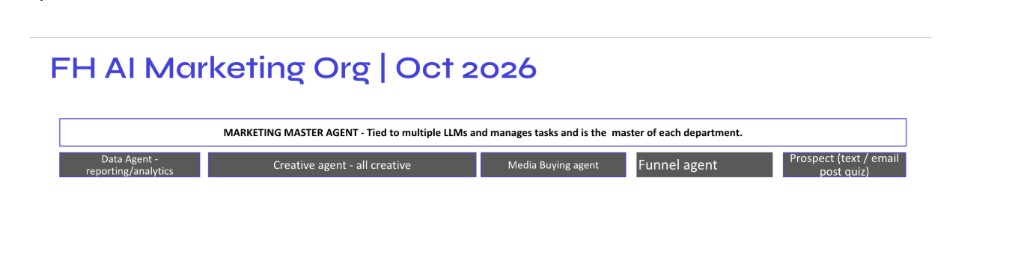
Master Agent (Orchestrator)
Tied to multiple LLMs. Manages tasks and is the master of each department. Routes requests to the appropriate specialist agent. Handles escalations, approvals, and cross-department coordination.
5 Specialist Agents
Marketing Master Agent
├── Data Agent          — reporting, analytics, dashboards
├── Creative Agent      — ad concepts, briefs, video generation
├── Media Buying Agent  — Meta/TikTok campaign management
├── Funnel Agent        — CRO, Sanity CMS, A/B test tracking
└── Prospect Agent      — email, SMS, post-quiz nurturing
Why Specialization Works
| Problem | Specialist Agent Fix |
|---|---|
| Context overload | Each agent carries only its domain knowledge |
| Memory slippage | Smaller, focused MEMORY files per agent |
| Task collision | No creative work competing with analytics for context |
| Reliability | Failures are isolated to one domain |
| Auditability | Each agent's outputs are domain-specific and verifiable |
| Scalability | Add capacity to bottleneck agents without touching others |
What This Section Contains
- Proposed Skills — candidate skills extracted from current patterns
- Proposed Agents — the 5 agents with integrations, skills, and responsibilities
- Integration Mapping — which integration goes to which agent
- Migration Plan — how to get from Sam to the multi-agent setup
For John & Luke
This architecture matches your March 18 diagram exactly. The main additions are:
- Explicit skill packages for each agent (reusable, testable)
- The Master Agent as an explicit orchestration layer
- A migration sequence that doesn't break what's working
The key question is sequencing: which agent to build first?